A Septic Maintenance Schedule You Can Print and Follow
A good septic routine is a yearly check, pumping about every 3 to 5 years, and careful habits every month: spread out water use, flush only toilet paper and waste, and keep chemicals out. A monthly additive is optional and never replaces pumping or inspection by a licensed pro.
Some links on this page are affiliate links: if you buy through them, we may earn a commission at no extra cost to you. Details
Septifix: Monthly flush-in septic tank tablets that the maker says release oxygen and add live aerobic bacteria.
Check Septifix on the official site60-day money-back guarantee

In this guide
- What does a septic maintenance schedule look like at a glance?
- What should you do every month?
- What needs doing once a year?
- How often should a 1,000-gallon septic tank be pumped?
- How much does septic maintenance cost per year?
- Where does an oxygen-releasing tablet fit in the routine?
- What if you already smell odor or see backups?
- Printable septic maintenance checklist
- How does this fit with the rest of your septic care?
What does a septic maintenance schedule look like at a glance?
A septic maintenance schedule has four parts: monthly habits, a yearly check, pumping every 3 to 5 years, and quick action when something looks off. Picture a house with a 1,000-gallon tank where nobody has pumped in years and the toilet starts gurgling. This schedule is meant to keep you from getting there.
| When | What to do |
|---|---|
| Monthly | Spread out water use, flush only toilet paper, walk the yard, optional additive |
| Yearly | Inspection, filter cleaning, lid and riser check, update records |
| Every 3 to 5 years | Pump the tank (sooner if measurements say so) |
| As needed | Call a licensed pro for backups, pooling water or strong odor |
Why those gaps? Solids settle to the bottom as sludge, and grease and light material float as scum. Think of the tank as a settling bucket that fills slowly. Pumping empties it before solids spill into the drain field, the buried area where treated water soaks into the soil.
How often do you need to pump? A city guide says to pump generally every three to five years, with an inspection about every three years. Our schedule suggests a yearly check to stay ahead of problems; systems with an aerator or pump usually need one at least yearly, and your local rules or service contract may set their own interval. Your own tank may differ. For more background, see our septic system basics.
What should you do every month?
Every month, your job is simple: go easy on the tank, check the yard and house for warning signs, and decide whether you want an additive.
Water and waste habits
The best monthly habit is spreading out your water use so the tank isn’t flooded all at once. A city guide warns that running the dishwasher, shower, washing machine and toilet at the same time strains the system.
- Do laundry across the week, not all on one day.
- Fix leaking toilets and dripping faucets.
- Flush only toilet paper and human waste. Wipes, floss, cat litter and feminine products go in the trash.
- Keep grease out of drains. Let it harden in a can, then bin it.
- Keep solvents, paint thinner, acids and strong chemicals out of the drains. They can harm the bacteria that work in the tank.
Quick walk-around checks
A five-minute monthly walk tells you a lot. Sniff near the tank and drain field. Look for soggy or unusually green patches over the field. Notice slow drains, gurgling pipes or a toilet that’s sluggish.
Quick tip: Write what you see on the checklist below, even if it’s “all normal.” Patterns are easier to spot on paper.
Should you use a monthly septic tank treatment?
A monthly septic tank treatment is optional. It’s a biological additive, meaning bacteria or enzymes (proteins that speed up breakdown) sold as tablets, pods, powder or liquid. Dose is usually set by tank size, so follow the label.
One expert quoted by a product review site says using treatments weekly or daily is a mistake because it can disrupt the tank’s balance. That same page says most products suit monthly use, though some run 3, 4, 6 or 12 months. Independent research on additives is limited, so treat them as a supplement. Never skip pumping.
What’s the best treatment? It’s the one that matches your tank size, fits your budget and that you’ll use as directed. Our septic tank treatment comparison lays out the types.
Is Dawn dish soap okay? Small amounts of ordinary dish soap in normal use are generally fine. Avoid heavy, constant loads of antibacterial or harsh cleaners. Our guide to septic safe cleaners goes deeper.
What needs doing once a year?
Once a year, book a professional inspection, which can include cleaning the effluent filter if you have one. Between visits, you can walk the drain field area and check that the lids are closed tight.
A licensed pro can measure sludge and scum levels. That’s the real answer to “is it time to pump?” They can also check baffles (the walls that guide flow in and out), the filter, and any pump or alarm.
Your yearly list:
- Schedule an inspection.
- Clean the effluent filter per its manufacturer’s instructions, or have the pro do it.
- Make sure risers and lids are secure and not cracked.
- Keep cars and heavy equipment off the drain field. A city guide says weight can damage drain lines.
- Keep trees and shrubs away. Roots can clog lines. Ask a septic pro how far is safe for your layout.
- Record the date, gallons pumped and anything the pro found.
Our drain field maintenance guide covers the yard side in more detail.
How often should a 1,000-gallon septic tank be pumped?
A 1,000-gallon tank serving a typical family is usually pumped about every 3 to 5 years, with bigger households near the short end.
The table below is a rough starting estimate, not a rule. Your sludge and scum measurements decide the real answer.
| Household size | 1,000-gallon tank | 1,500-gallon tank |
|---|---|---|
| 2 people | Toward 5 years | Often 5 years or more |
| 4 people | Around 3 to 4 years | Around 4 to 5 years |
| 6 people | Toward 3 years or sooner | Around 3 to 4 years |
These ranges are typical rules of thumb, not published standards. Ask your pro to confirm.
Rule of thumb by household size
More people means more water and waste, so the tank fills faster. A larger tank gives solids more room, so a 1,500-gallon tank often goes longer between pumpings.
What changes the interval
Several things shorten the gap:
- A garbage disposal, which adds solids
- Heavy laundry or water use
- A big household or guests
- Grease and wipes going down the drain
Local rules may set a required interval, so check with your county or health department. Not sure of your tank size? Look at paperwork from the install or ask a pro to find the lid and measure.
How much does septic maintenance cost per year?
Routine septic care costs a small fraction of a drain field repair, and you can budget it by spreading pumping over the years between visits.
Typical costs to budget
Pumping prices vary by region and tank size, so get two or three local quotes. Divide one quote by the years between pumpings to get a yearly number. Add the yearly inspection fee. If you use an additive, ranking pages list products at roughly $8 to $35 per month, depending on the brand.
For example, a quote of $400 for pumping every 4 years works out to $100 a year. Your numbers will differ.
Pump replacement and bigger repairs
If your system has a pump (common with some sloped or low-lying lots), replacing it can cost several hundred to a few thousand dollars depending on type, depth and region. I can’t give a firm price, so ask for written quotes. A failed drain field costs far more, and that’s why routine care is worth the small yearly spend.
Costs like these are why some owners look at add-ons. One option is below.
Where does an oxygen-releasing tablet fit in the routine?
An oxygen-releasing tablet like Septifix would be one optional monthly step, alongside good habits, never in place of pumping or inspection.
The maker describes Septifix as 55-gram tablets with live aerobic bacteria (bacteria that use oxygen) and an oxygen-releasing compound, flushed down the toilet. The maker’s directions call for 3 tablets to start, then 1 per month. The maker says it helps reduce odors and keep the tank balanced. The maker hasn’t published independent test results for Septifix, so treat those claims as the maker’s.
Price, per the maker: $69 for 6 months (plus shipping), $118 for 12 months, or $147 for 18 months, with a 60-day money-back guarantee. We may earn a commission if you buy through our link. More detail is in our Septifix review.
Who should skip it:
- Anyone with active backups or sewage odor. Call a pro first.
- A tank that’s overdue for pumping.
- Anyone whose septic pro advises against additives.
- Anyone hoping to fix a failed drain field or damaged tank. No tablet can.
Check the current Septifix offer and the 60-day refund terms on the official site.
Check Septifix on the official site60-day money-back guarantee
What if you already smell odor or see backups?
If you smell sewage or see backups, cut back on water use and call a licensed septic pro. An additive is not an emergency fix.
| Symptom | Likely cause | What to do first |
|---|---|---|
| Sewage smell indoors | Dry drain trap, vent issue, or full tank | Run water in unused drains, then call a pro if it stays |
| Slow drains or gurgling | Clog or a tank near full | Limit water use; schedule an inspection |
| Toilets or sinks backing up | Blocked line or overfull tank | Stop water use, call a pro now |
| Soggy ground or pooling over field | Drain field stress | Keep people and pets off, call a pro |
| Alarm sounding | Pump or high water issue | Limit water use, call a pro |
For smell-specific steps, see septic tank smell in the house.
Can you live in the house during a septic replacement? Often yes for a short stretch, but you may have limited water use while work happens. Ask your contractor and local health office about timing.
Printable septic maintenance checklist
This checklist puts every task in one place so you can print it and tape it inside a cabinet.
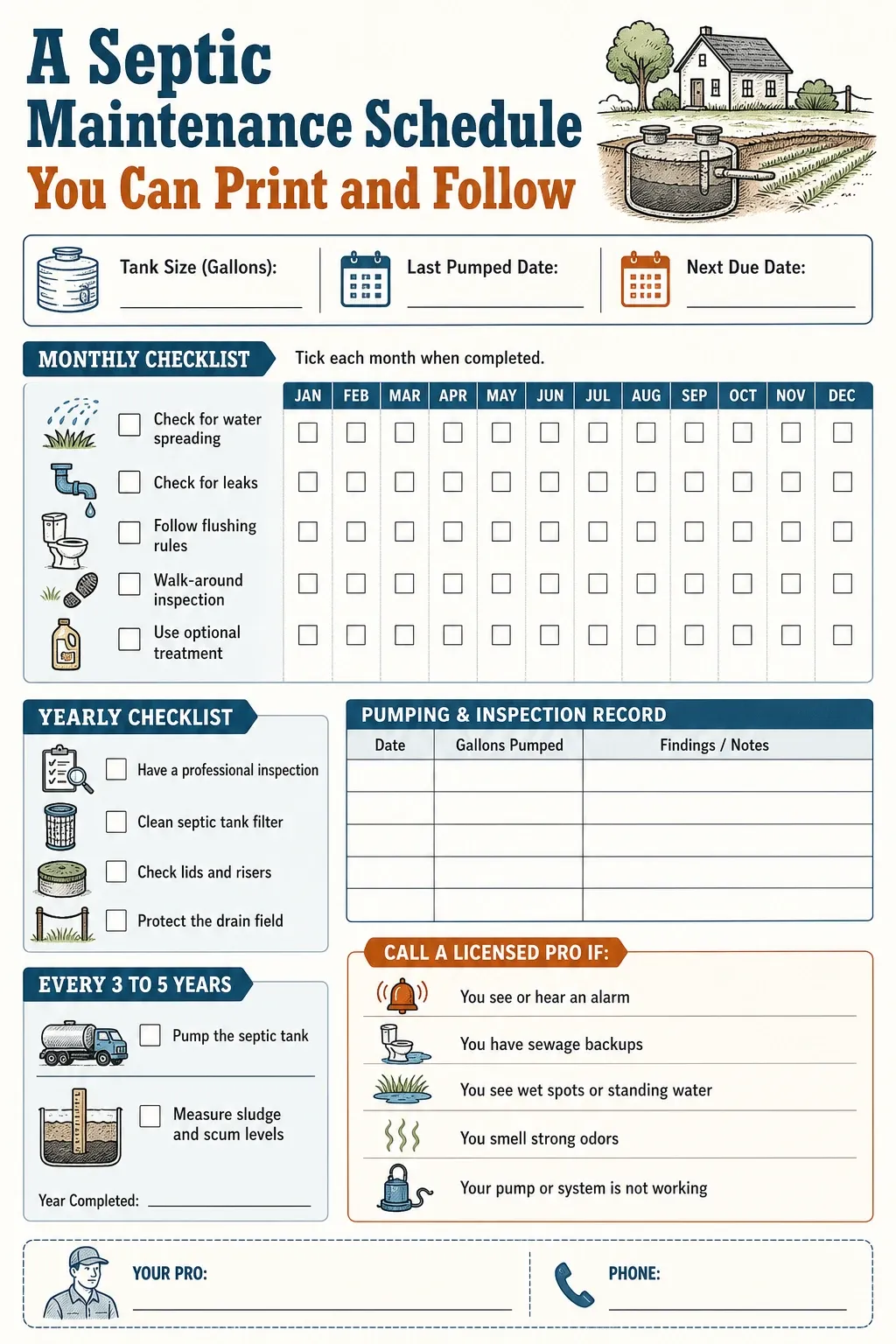
Monthly
- Spread out laundry and other heavy water use
- Check toilets and faucets for leaks
- Flush only toilet paper
- Walk the yard and sniff near the tank and field
- Note slow drains or gurgling
- Optional: add treatment per its label
Yearly
- Book an inspection
- Clean the effluent filter
- Check lids and risers
- Keep vehicles and roots off the field
- Log date, gallons and findings
Every 3 to 5 years
- Pump the tank
- Ask for sludge and scum measurements
- Update “last pumped” and “next due”
Call a licensed pro if
- An alarm sounds
- Drains or toilets back up
- Wet spots or pooling appear over the field
- You notice a strong sewage odor
- A pump fails
How does this fit with the rest of your septic care?
This schedule is the practical, dated version of the bigger picture in septic tank maintenance: what to do between pumpings. Use that page for the reasoning behind each habit.
If you’re weighing additives, do septic tank treatments work? walks through what’s known. And if you want the full layout of tank, pipes and field, see septic system components explained.
Your next step: find your tank size and last pumping date, fill them into the checklist, and book the yearly inspection.
Common questions
Can I use bleach and cleaners with a septic tank?
Small amounts of household cleaners used as directed are usually fine. Large or constant amounts of bleach, disinfectants, solvents or acids can harm the bacteria in your tank. Spread cleaning out, choose milder products when you can, and never pour chemicals or paint thinner down the drain.
Does a garbage disposal change my pumping schedule?
Yes. A disposal sends extra solids into the tank, so it fills with sludge faster and you may need pumping sooner. Many septic guides suggest limiting or skipping one. If you use it, ask your pro to measure sludge and scum each year.
How do I find my tank's size?
Check your install or permit paperwork first, since it often lists gallons. Your county health office may have records on file. If not, a licensed septic pro can locate the lid, open it and estimate the size while doing an inspection or pumping.